Learn about nasolabial cyst symptoms, diagnosis, and treatment options at Patil ENT Hospital, Nashik, with Dr. Rahul Dilip Patil, MS ENT. All cashless facility available, subject to insurance approval.
Nasolabial Cyst


6
1. Nasolabial Cyst: Overview
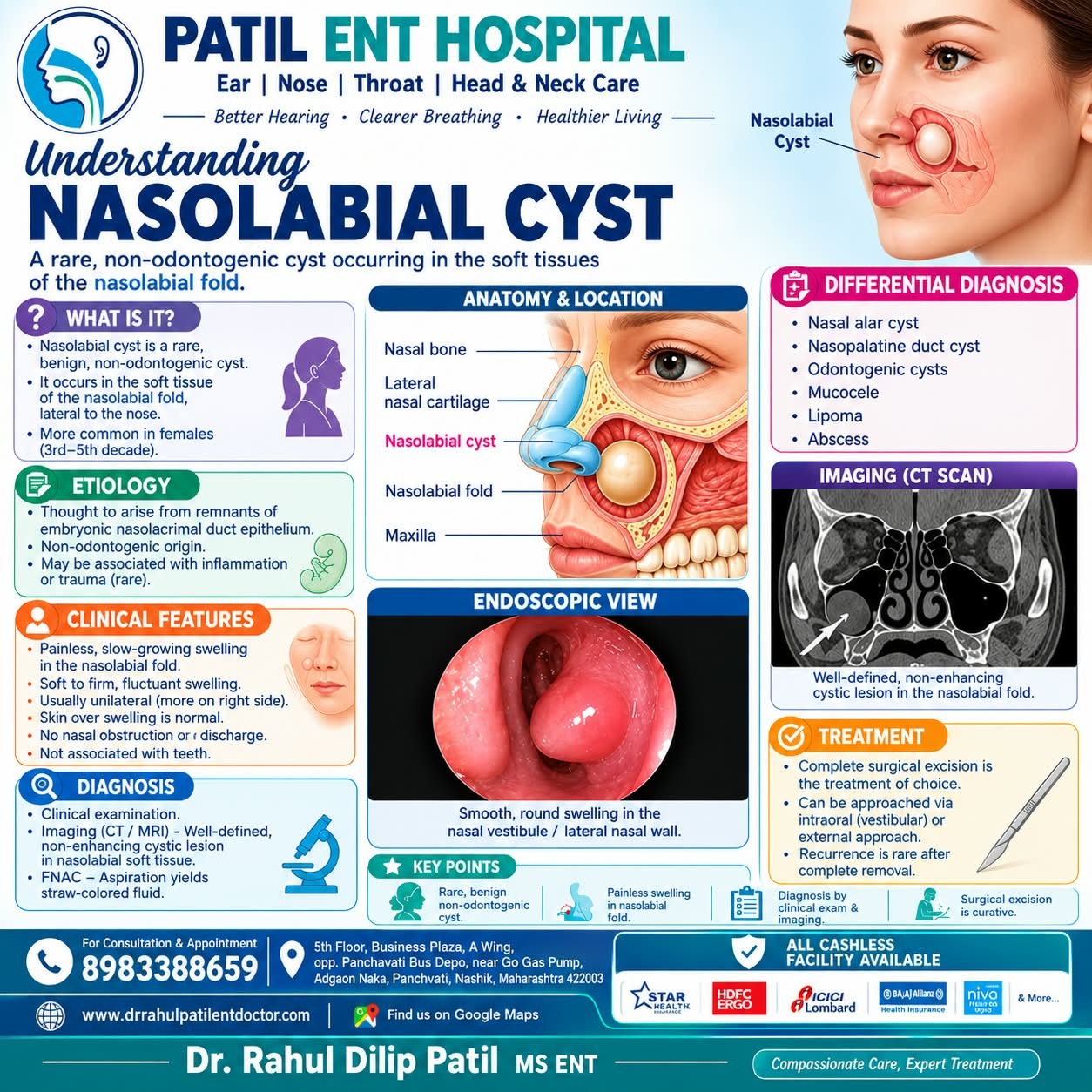
A nasolabial cyst is a rare, benign, non-cancerous soft-tissue cyst that develops near the base of the nose, typically between the upper lip and the nasal opening. It is also known as a nasoalveolar cyst. It usually occurs outside the nasal cavity and may gradually cause swelling, facial asymmetry, or difficulty breathing through the affected nostril.
At Patil ENT Hospital, Nashik, patients with swelling near the nose, upper lip discomfort, or suspected nasolabial cyst can undergo clinical evaluation and receive advice regarding appropriate treatment options.
All Cashless Facility Available — cashless treatment is subject to the patient's insurance policy, insurer/TPA approval, and hospital eligibility.
2. Signs and Symptoms of a Nasolabial Cyst
Common signs and symptoms include:
- Swelling near the nose: A soft swelling at the junction of the nose and upper lip, usually on one side.
- Upper lip swelling: A lump may elevate the upper lip or flatten the natural fold beside the nose.
- Nasal obstruction: A larger cyst can narrow the affected nasal opening.
- Facial asymmetry: Visible swelling may change the appearance of the nose or upper lip.
- Pain or tenderness: Usually absent in an uncomplicated cyst, but may occur if infection develops.
- Redness and discharge: Possible when the cyst becomes infected or drains.
- Difficulty wearing dentures: Occasionally, the swelling may interfere with denture fitting.
Some nasolabial cysts remain painless and may go unnoticed until they become larger or infected.
3. Causes of Nasolabial Cyst
The exact origin is not completely established. One widely accepted explanation is that the cyst develops from epithelial remnants associated with embryonic development of the face and nasal structures.
Possible contributing factors include:
- Congenital epithelial remnants.
- Gradual accumulation of fluid within the cyst.
- Enlargement over time.
- Secondary infection, which may cause pain and swelling.
Nasolabial cysts are benign and are not generally considered cancerous.
4. Diagnosis of Nasolabial Cyst
An ENT specialist may recommend the following assessments:
Clinical examination: Examination of the nose, upper lip, nasal floor, and surrounding facial tissues.
Nasal examination: Anterior rhinoscopy or nasal endoscopy may help assess whether the cyst extends into or compresses the nasal cavity.
Imaging: CT or MRI may be recommended when the diagnosis is uncertain, the cyst is large, or its relationship to surrounding structures needs clarification.
Differential diagnosis: Other conditions, including dental infections, odontogenic cysts, and other soft-tissue lesions, may need to be excluded.
The final diagnosis is based on the clinical findings and any necessary investigations.
5. Treatment Options for Nasolabial Cyst
Treatment depends on the size of the cyst, symptoms, infection, and the patient's overall condition.
A. Observation
Small, asymptomatic cysts may sometimes be monitored after appropriate medical evaluation.
B. Treatment of infection
If the cyst is infected, a doctor may prescribe appropriate medication or recommend drainage when indicated. Antibiotics alone do not usually eliminate the cyst itself.
C. Surgical excision
Complete surgical removal through a sublabial approach, using an incision inside the upper lip, is a well-established treatment option. It allows the surgeon to remove the cyst while avoiding an external facial scar.
D. Endoscopic transnasal treatment
In selected cases, endoscopic transnasal marsupialization may be considered. This technique creates an opening into the nasal cavity to allow the cyst to drain and remain decompressed.
The most appropriate procedure depends on the individual patient's anatomy and clinical assessment.
6. Benefits of Appropriate Treatment
Timely assessment and suitable treatment can help:
- Reduce swelling near the nose and upper lip.
- Relieve nasal obstruction caused by the cyst.
- Treat recurrent infection or discomfort.
- Improve facial symmetry when swelling is significant.
- Reduce the risk of recurrence when definitive treatment is successful.
As with any procedure, possible complications include bleeding, infection, scarring within tissues, and recurrence. These risks should be discussed with the treating ENT surgeon.
7. When Should You Consult an ENT Specialist?
Seek an ENT assessment if you notice:
- Persistent swelling beside the nose.
- A lump between the nose and upper lip.
- Repeated infection or tenderness in the same area.
- Nasal blockage associated with facial swelling.
- Rapidly increasing swelling, fever, severe pain, or spreading redness.
Rapidly progressive swelling with fever or spreading redness requires prompt medical attention.
8. Nasolabial Cyst Treatment at Patil ENT Hospital, Nashik

Patil ENT Hospital
Dr. Rahul Dilip Patil, MS ENT
Patients with suspected nasolabial cysts can consult an ENT specialist for clinical evaluation, appropriate investigations, and discussion of suitable treatment options.
All Cashless Facility Available*
Hospital address: 5th Floor, Business Plaza, A Wing, Opp. Panchavati Bus Depot, Near Go Gas Pump, Adgaon Naka, Panchavati, Nashik, Maharashtra – 422003.
Website: www.drrahulpatilentdoctor.com
Cashless facility is subject to insurance coverage, policy terms, network eligibility, and insurer/TPA authorization.
Keywords