Unsafe CSOM (Cholesteatoma) requires specialist ENT evaluation and often surgery. Patil ENT Hospital, Nashik provides advanced ear microscopy, endoscopic ear evaluation, mastoidectomy and tympanoplasty with cashless insurance/TPA assistance, subject to policy approval.
Cashless ENT Hospital in nashik 🔴 Unsafe CSOM (Cholesteatoma) — Symptoms, Complications & Treatment
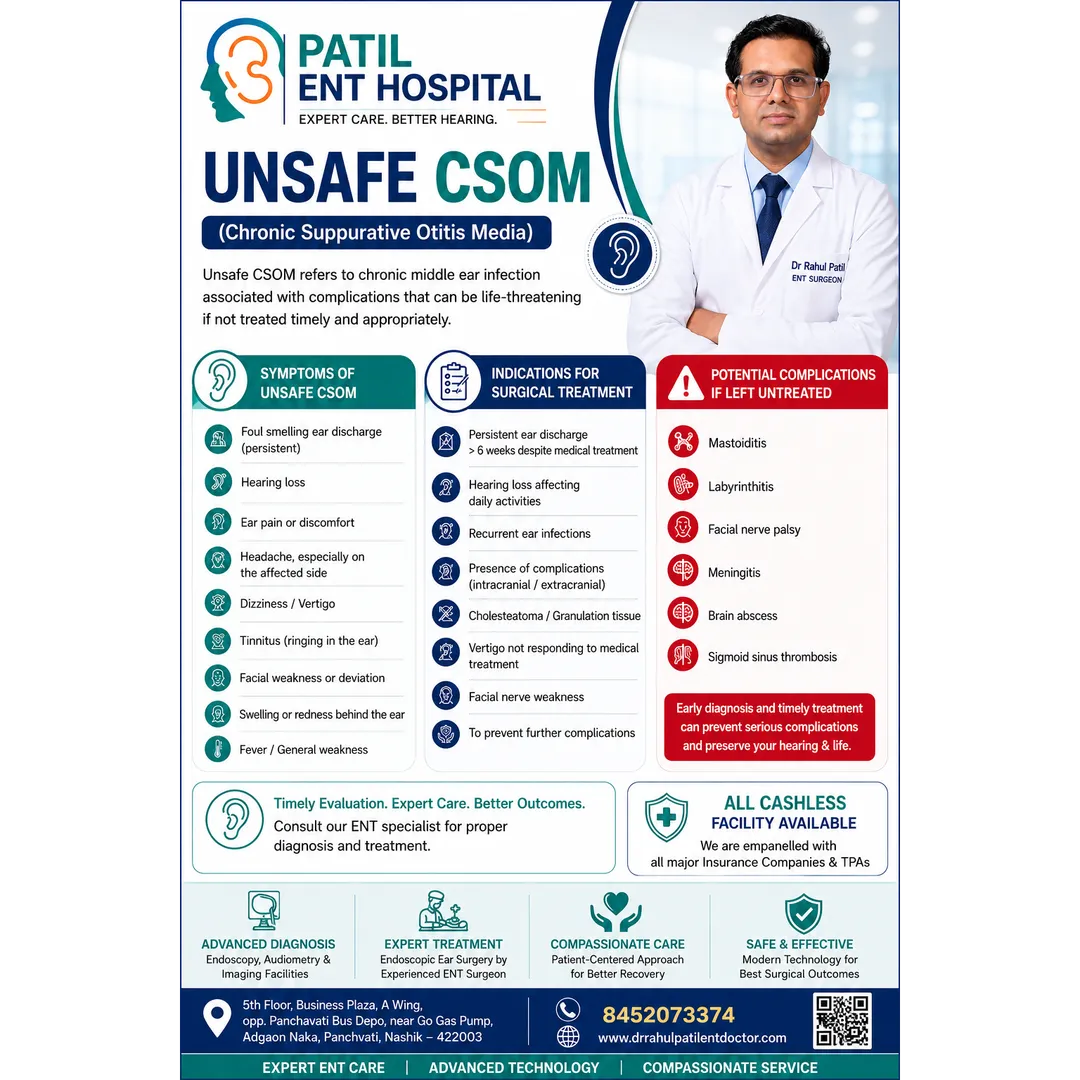
Unsafe CSOM, commonly associated with cholesteatoma or attico-antral disease, is a potentially destructive chronic middle-ear condition. Unlike uncomplicated chronic ear disease, cholesteatoma can progressively erode the tiny bones of the middle ear and surrounding bone and may cause serious complications if left untreated.
The Indian Ministry of Health and Family Welfare's standard treatment guidance describes unsafe CSOM with features such as foul-smelling discharge, hearing impairment, retraction/perforation with whitish flakes, granulation or polyps, and recommends urgent ENT specialist referral because serious complications can occur. (Clinical Establishments)
What is Unsafe CSOM?
Unsafe CSOM is chronic middle-ear disease in which cholesteatoma and/or disease in the attic and mastoid can progressively damage normal ear structures.
A cholesteatoma is not a cancer. It is an abnormal collection of keratinizing squamous epithelium within the middle ear/mastoid that can expand and erode surrounding bone.
The WHO describes cholesteatoma and attico-antral disease as conditions that are generally considered surgical diseases, because medication may not adequately reach or eradicate disease hidden in the attic and mastoid. (Iris)
🚨 Signs & Symptoms of Unsafe CSOM
Patients may present with:
Common symptoms
- Foul-smelling ear discharge
- Persistent or recurrent ear discharge
- Hearing loss
- Ear blockage/fullness
- Tinnitus
- Recurrent ear infections
- Ear pain in some cases
- Occasionally dizziness/vertigo
Ear examination may show
- Attic retraction pocket
- Marginal or attic perforation
- Whitish keratin debris
- Granulation tissue
- Aural polyp
- Diseased middle-ear mucosa
- Evidence of ossicular erosion
The presence of foul-smelling discharge, keratin debris, granulation or an attic/marginal disease pattern should prompt specialist assessment for cholesteatoma. (Clinical Establishments)
⚠️ Why is Unsafe CSOM Dangerous?
Untreated cholesteatoma can progressively destroy:
- Tympanic membrane
- Malleus
- Incus
- Stapes
- Mastoid bone
- Facial nerve canal
- Inner-ear structures
Rare but serious complications include:
- Facial nerve weakness/paralysis
- Labyrinthitis
- Mastoid abscess
- Lateral sinus thrombosis
- Meningitis
- Brain abscess
- Other intracranial complications
WHO guidance specifically identifies complications such as facial nerve paralysis, suppurative labyrinthitis, brain abscess and meningitis as conditions requiring urgent surgical management. (Iris)
🔎 Diagnosis of Unsafe CSOM
At Patil ENT Hospital, assessment can include:
1. ENT Examination
Detailed examination of the ear canal and tympanic membrane.
2. Video Otoscopy / Ear Microscopy
Magnified visualization helps identify retraction pockets, keratin, granulation and perforation.
3. Audiometry
Pure-tone audiometry evaluates the degree and type of hearing loss.
4. Tympanometry
Useful for evaluating middle-ear function when appropriate.
5. Endoscopic Ear Examination
High-definition endoscopic visualization can provide detailed assessment of the ear canal and tympanic membrane.
6. HRCT Temporal Bone
CT of the temporal bone may be advised when the extent of cholesteatoma, mastoid involvement or bony erosion needs evaluation.
Patil ENT Hospital's published facilities include video otoscopy, ear microscopy, audiology, Storz endoscope/HD camera technology, endoscopic ear surgery and mastoidectomy facilities. (Dr Rahul Patil ENT Doctor)
🏥 Treatment of Unsafe CSOM
Treatment depends on the extent and location of disease.
1. Medical Treatment
Medical treatment may help control active infection and discharge before surgery.
Treatment may include:
- Aural toilet / suction cleaning
- Appropriate topical antibiotic drops
- Treatment of associated infection
- Pain control
- Selected systemic antibiotics when clinically indicated
However, antibiotics alone generally cannot eradicate an established cholesteatoma. Recent evidence also shows limited certainty regarding the additional benefit of systemic antibiotics over topical therapy for CSOM. (Cochrane)
2. Surgical Treatment — Definitive Management
When cholesteatoma is present, the principal objective is:
'Safe, dry ear + disease eradication + hearing preservation/restoration whenever possible.'
Depending on disease extent, surgery may include:
Mastoidectomy
Removal of diseased tissue/cholesteatoma from the mastoid and middle ear.
Tympanoplasty
Repair of the perforated tympanic membrane.
Ossiculoplasty
Reconstruction of damaged hearing bones when required.
Canal Wall Up / Canal Wall Down Surgery
The appropriate mastoidectomy technique is selected according to disease extent, anatomy, recurrence risk and surgeon assessment.
Staged / Revision Surgery
Some extensive or recurrent cholesteatomas may require staged or revision procedures.
The choice of operation should be individualized rather than described as one procedure being suitable for every patient. Surgical management of cholesteatoma is challenging because disease extent and recurrence risk vary considerably. (Cambridge University Press)
📊 Evidence & Meta-analysis
A systematic review of CSOM treatments found evidence covering topical ear cleansing, topical/systemic antibiotics, tympanoplasty, mastoidectomy and cholesteatoma surgery, but also highlighted variability in the quality of evidence. (PubMed Central (PMC))
More recent evidence confirms that persistent CSOM can cause significant hearing-related morbidity and that persistent disease or cholesteatoma may require surgery for long-term disease control. (PubMed)
A systematic review and meta-analysis examining mastoid surgery for cholesteatoma evaluated 267 identified studies, with 12 included in qualitative synthesis and 11 in the meta-analysis. It specifically compared outcomes such as recurrence, otorrhoea, reoperation and hearing outcomes across mastoidectomy/obliteration strategies. This supports the principle that surgical technique should be selected according to the extent and characteristics of cholesteatoma rather than applying one operation universally. (ScienceDirect)
Hearing outcomes after chronic otitis media/cholesteatoma surgery are also influenced by the condition of the ossicular chain. A systematic review/meta-analysis found that preoperative ossicular status, particularly the presence of the malleus, can influence postoperative air-bone gap outcomes. (JAMA Network)
Clinical takeaway
Unsafe CSOM is primarily a disease-eradication problem, not simply an ear-discharge problem. Early ENT assessment and appropriate surgery can prevent progressive bone destruction and serious complications while providing an opportunity for hearing reconstruction.
⭐ Why Choose Patil ENT Hospital, Nashik?
Patil ENT Hospital provides comprehensive ear, nose and throat care under one roof. The hospital's published facilities include:
- 👂 Ear Microscopy
- 🔬 High-definition Storz Endoscope & Camera System
- 🎥 Video Otoscopy
- 🎧 Pure Tone Audiometry
- 📈 Tympanometry
- 🏥 Modular Operation Theatre
- 🔪 Endoscopic Ear Surgery
- 🦻 Tympanoplasty
- 🦴 Mastoidectomy
- 🔧 Ossicular reconstruction when clinically indicated
- 🏠 Day-care and inpatient surgical care
- 🧾 Cashless Insurance / TPA Assistance
These facilities are listed on the hospital's current website. (Dr Rahul Patil ENT Doctor💳 Cashless Insurance & TPA Facility
Patil ENT Hospital provides cashless treatment/insurance assistance through various insurance companies and TPAs, subject to policy coverage, eligibility, pre-authorization and insurer/TPA approval. (Dr Rahul Patil ENT Doctor)
For a website/SLO, I recommend using “Cashless Insurance & TPA Facility Available” rather than claiming that every insurer is cashless, because cashless availability depends on the patient's current policy and insurer/TPA authorization.
Cashless Support Can Include
- Pre-authorization assistance
- Insurance documentation
- TPA coordination
- Cashless admission process
- Claim-related documentation
- Discharge coordination
- Insurance desk support
🏆 SLO Highlight
UNSAFE CSOM / CHOLESTEATOMA
Don't Ignore Persistent Foul-Smelling Ear Discharge
Foul-smelling discharge • Hearing Loss • Attic Perforation • Cholesteatoma • Granulation • Ear Polyp
Early ENT Evaluation Can Prevent Serious Complications
Advanced Ear Microscopy | HD Endoscopy | Mastoidectomy | Tympanoplasty | Ossiculoplasty
PATIL ENT HOSPITAL – NASHIK
Advanced Endoscopic & Microsurgical ENT Care
Cashless Insurance & TPA Assistance Available*
*Subject to policy terms, eligibility and insurer/TPA approval.
📍 Patil ENT Hospital
5th Floor, Business Plaza, A Wing, Opp. Panchavati Bus Depot, Near Go Gas Pump, Adgaon Naka, Panchvati, Nashik – 422003, Maharashtra.
Dr. Rahul Dilip Patil, MBBS, MS (ENT) — the hospital's website identifies him as the ENT specialist leading patient care. (Dr Rahul Patil ENT Doctor)
Keywords