Learn about otosclerosis symptoms, causes, diagnosis and treatment including hearing aids and stapedotomy surgery. Consult Patil ENT Hospital, Nashik. Cashless facility available for eligible patients.
Absolutely. Below is SEO-optimized, patient-friendly website content for Otosclerosis, tailored for Patil ENT Hospital, Nashik, including symptoms, diagnosis, treatment options, surgery, and cashless facility information.
Otosclerosis: Symptoms, Diagnosis and Treatment
What is Otosclerosis?
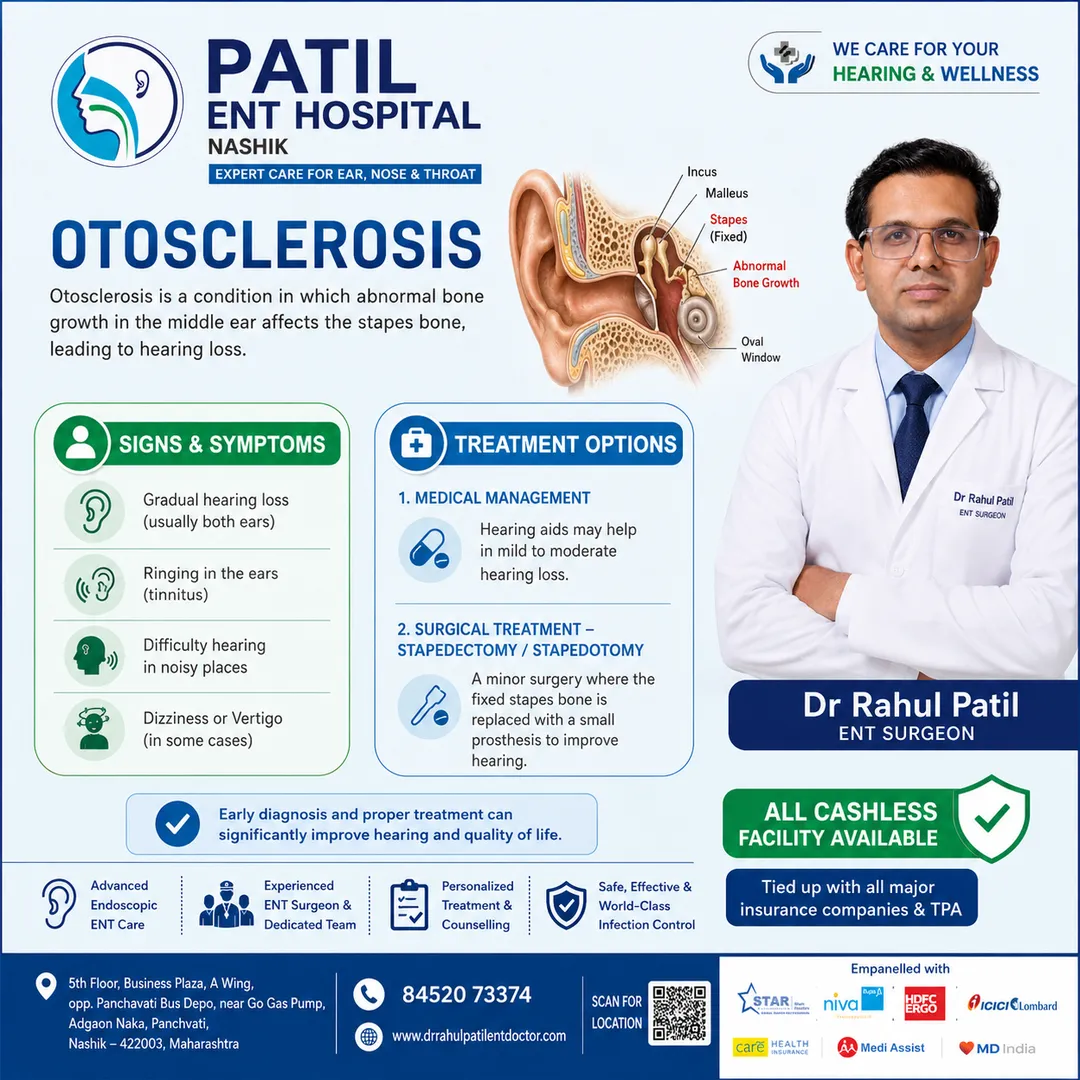
Otosclerosis is a condition of the middle and inner ear in which abnormal bone growth develops around the tiny hearing bones, most commonly the stapes. This can prevent the stapes from moving normally and gradually cause conductive hearing loss.
In some patients, otosclerosis can also affect the inner ear and result in sensorineural hearing loss.
Otosclerosis is an important but treatable cause of progressive hearing loss, particularly in young and middle-aged adults. Early evaluation by an experienced ENT specialist can help determine the cause of hearing loss and the most appropriate treatment.


Symptoms of Otosclerosis
Symptoms can develop gradually and may initially be difficult to notice.
Common symptoms include:
- Gradually progressive hearing loss
- Hearing loss that may initially affect one ear or both ears
- Difficulty understanding conversations, particularly in noisy environments
- Feeling that people are mumbling or speaking unclearly
- Tinnitus or ringing/buzzing sounds in the ear
- Occasionally, dizziness or balance-related symptoms
- A sensation that hearing is better in quiet surroundings
- Difficulty hearing low-pitched sounds in some patients
- Increasing dependence on higher television or mobile-phone volume
A characteristic feature reported by some patients is paracusis Willisii, where speech may seem easier to understand in noisy environments than in quiet surroundings.
Causes and Risk Factors
The exact cause of otosclerosis is not completely understood. Both genetic and environmental factors may contribute.
Possible factors include:
- Family history of otosclerosis
- Genetic predisposition
- Female sex is associated with a higher prevalence
- Hormonal factors may influence progression in some patients
- Certain viral and environmental factors have been investigated, although the exact relationship remains uncertain
Having a family history does not necessarily mean that a person will develop significant hearing loss.
How is Otosclerosis Diagnosed?
A detailed evaluation by an ENT surgeon is important because several other conditions can produce similar hearing symptoms.
Evaluation may include:
1. Ear examination
The ear canal and eardrum are examined using an otoscope or microscope. In typical otosclerosis, the eardrum may appear normal.
2. Pure Tone Audiometry
A hearing test measures hearing thresholds and helps determine whether the hearing loss is conductive, sensorineural, or mixed.
3. Tympanometry
Tympanometry evaluates middle-ear function. A characteristic Type As tympanogram may be found in some patients with stapes fixation.
4. Speech Audiometry
Speech testing evaluates how well the patient can hear and understand spoken words.
5. CT scan of the temporal bone
High-resolution CT may be recommended in selected patients, particularly when the diagnosis is uncertain or before surgery.
Otosclerosis Treatment
Treatment depends on the severity and type of hearing loss, the patient's symptoms, age, lifestyle, and personal preference.
1. Observation and Regular Hearing Tests
Patients with mild or stable hearing loss may sometimes be monitored with periodic audiometry.
2. Hearing Aids
Hearing aids can improve hearing in patients with otosclerosis and may be appropriate for:
- Mild to moderate hearing loss
- Patients who do not want surgery
- Patients who are not suitable candidates for surgery
- Patients with significant sensorineural or mixed hearing loss
Modern digital hearing aids can provide substantial improvement in communication.
3. Stapedotomy / Stapedectomy
For suitable patients with stapes fixation causing conductive hearing loss, surgery can provide significant hearing improvement.
Stapedotomy
Stapedotomy is a microsurgical procedure in which a very small opening is created in the fixed stapes footplate and a prosthesis is placed to restore transmission of sound to the inner ear.
It is one of the established surgical treatments for otosclerosis.
Endoscopic Stapedotomy
An endoscopic approach may be used in selected patients. The endoscope provides a magnified, wide-angle view of the middle ear and can allow visualization of structures that may be difficult to see with a conventional microscopic view.
The choice between an endoscopic and microscopic approach depends on the patient's anatomy, surgeon expertise, hearing findings, and individual case.


Benefits of Stapedotomy Surgery
In appropriately selected patients, stapedotomy can:
- Improve conductive hearing loss
- Improve speech understanding
- Reduce dependence on hearing aids in some patients
- Improve communication in daily life
- Provide long-term hearing benefit
However, no surgery can guarantee a specific hearing outcome, and patients should discuss potential benefits and risks with their ENT surgeon.
Risks and Complications
Although stapedotomy is generally a well-established procedure, potential complications should be discussed before surgery.
Possible risks include:
- Persistent or recurrent hearing loss
- Sensorineural hearing loss
- Tinnitus
- Dizziness or imbalance
- Taste disturbance
- Eardrum or ear-canal problems
- Prosthesis-related complications
- Rarely, significant or profound hearing loss
The surgeon will explain the expected benefits and individual risks during the preoperative consultation.
When Should You Consult an ENT Specialist?
You should consider an ENT evaluation if you experience:
- Gradually worsening hearing
- Hearing difficulty in conversations
- Persistent tinnitus
- Hearing loss in both ears
- Difficulty hearing despite increasing television volume
- A family history of progressive hearing loss
- Hearing loss that is affecting work or daily communication
Early assessment can help identify whether the hearing loss is due to otosclerosis or another treatable ear condition.
Otosclerosis Treatment in Nashik
If you are looking for otosclerosis treatment in Nashik, ENT evaluation with audiological testing is an important first step.
Patil ENT Hospital, Nashik provides evaluation and treatment for patients with hearing disorders, including assessment of suspected otosclerosis and discussion of appropriate treatment options such as hearing rehabilitation and stapes surgery when indicated.
Patil ENT Hospital
Address:
5th Floor, Business Plaza, A Wing,
Opp. Panchavati Bus Depot, Near Go Gas Pump,
Adgaon Naka, Panchvati,
Nashik – 422003, Maharashtra.
Website: Dr Rahul Patil / Patil ENT Hospital
Cashless Facility:
Cashless facility available for eligible insurance/TPA patients, subject to insurer/TPA authorization, policy terms, network status, and applicable hospital procedures.
Keywords