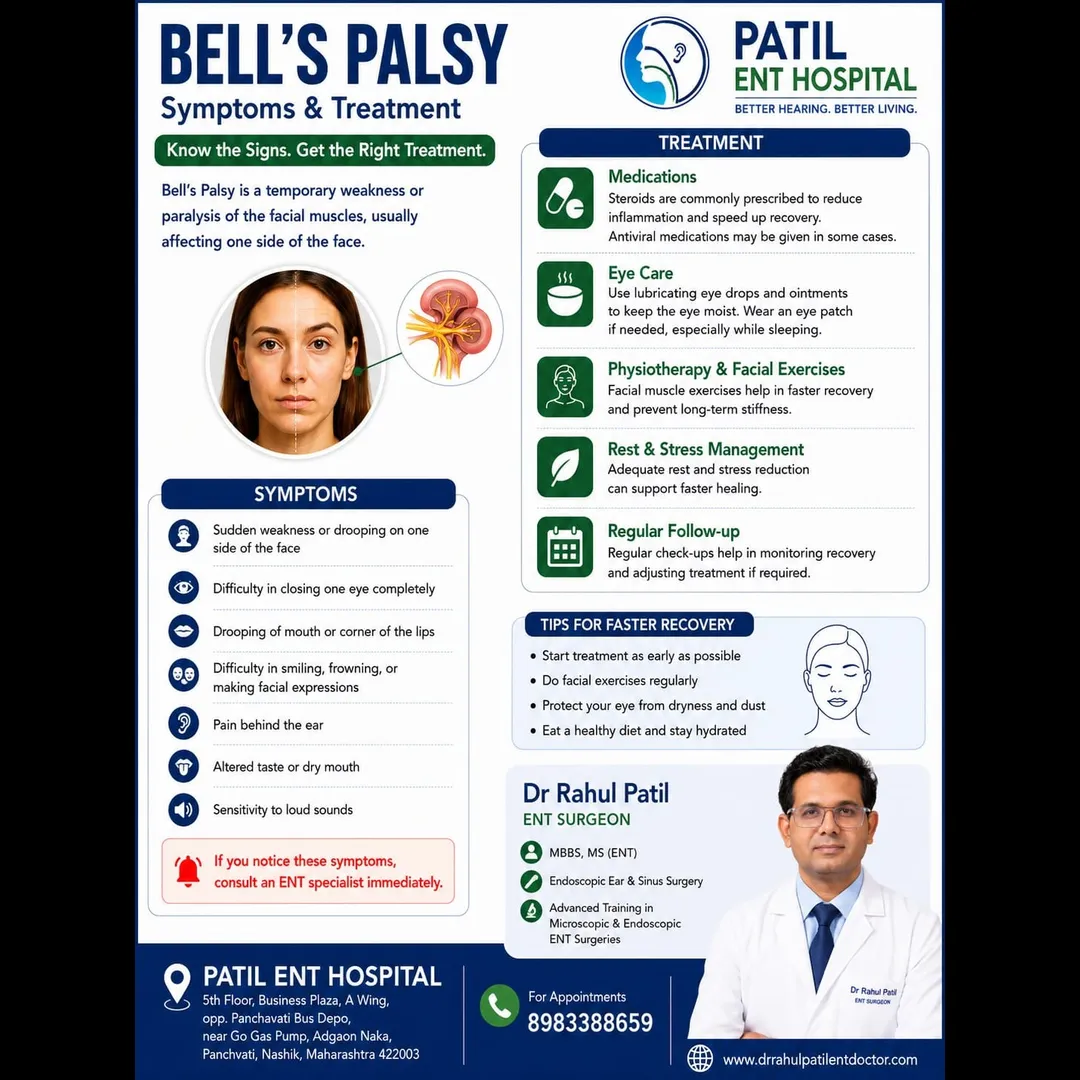
Looking for Bell’s Palsy treatment in Nashik? Patil ENT Hospital provides ENT evaluation, facial nerve palsy management, early treatment, eye-care guidance and follow-up with cashless insurance & TPA facility.
Bell’s Palsy – What Is It?
Bell’s Palsy is a sudden weakness or paralysis of one side of the face caused by dysfunction of the facial nerve (7th cranial nerve). It commonly develops over one to three days and may affect facial movements, eye closure, taste and sometimes hearing sensitivity.
Bell’s Palsy is one of the most common causes of sudden facial paralysis. Most patients have a favourable recovery, particularly when appropriate treatment is started early. More than two-thirds of patients with typical Bell’s Palsy achieve complete recovery.
Symptoms of Bell’s Palsy
Common symptoms include:
- Sudden weakness of one side of the face
- Drooping of the corner of the mouth
- Difficulty smiling
- Difficulty closing one eye
- Reduced forehead movement
- Difficulty drinking or retaining liquids
- Altered or reduced taste sensation
- Increased sensitivity to sound
- Pain around or behind the ear
- Excessive watering or dryness of the affected eye
- Difficulty with facial expressions
Symptoms generally reach their maximum severity within the first week and may gradually improve over the following weeks to months.
What Causes Bell’s Palsy?
The exact cause of idiopathic Bell’s Palsy is not always known. Swelling and inflammation of the facial nerve within its narrow bony canal are thought to play an important role.
Facial paralysis can also occur because of other conditions such as infections, trauma, tumours, ear disease, neurological disorders or other causes. Therefore, sudden facial paralysis should be properly evaluated by an ENT specialist.
Bell’s Palsy Diagnosis
Diagnosis is primarily clinical and includes:
- Detailed medical history
- Examination of facial movements
- Assessment of forehead movement
- Assessment of eye closure
- Examination of the ear
- Facial nerve function assessment
- Assessment using facial nerve grading systems such as House-Brackmann grading
Typical Bell’s Palsy does not routinely require CT or MRI. Additional investigations may be recommended when symptoms are atypical, progressive, recurrent or do not follow the expected recovery pattern.
Bell’s Palsy Treatment
1. Corticosteroid Treatment
Oral corticosteroids are the main evidence-based treatment for Bell’s Palsy. Treatment is most beneficial when initiated early, preferably within 72 hours of onset. Clinical evidence and meta-analyses support corticosteroids for improving the likelihood of complete recovery.
The exact medicine and dosage should be decided by the treating ENT specialist after considering the patient's age, medical history, diabetes, blood pressure, pregnancy status and other contraindications.
2. Antiviral Medication
Antiviral medication may be considered in selected patients, particularly those with severe facial paralysis. However, antiviral medication should not be used as the only treatment for Bell’s Palsy.
3. Eye Protection
If the patient cannot completely close the affected eye, protecting the cornea is extremely important.
Treatment may include:
- Lubricating eye drops
- Lubricating eye gel
- Night-time eyelid protection/taping when advised
- Ophthalmology assessment if there is eye pain, redness or visual disturbance
Failure to protect an incompletely closing eye can result in corneal complications.
4. Facial Rehabilitation
Patients with severe or persistent facial weakness may benefit from facial rehabilitation under appropriate specialist guidance. Facial physiotherapy can be considered particularly in severe paralysis or persistent weakness lasting more than three months.
Bell’s Palsy Recovery
Recovery varies according to the severity of facial nerve involvement.
Many patients begin to improve within weeks, with further recovery occurring over the following months. Some patients may have residual weakness or develop synkinesis, in which facial muscles move involuntarily together because of abnormal nerve regeneration.
Early diagnosis and appropriate treatment can help optimise recovery.
When Is Bell’s Palsy an Emergency?
Not every case of sudden facial weakness is Bell’s Palsy.
If facial weakness occurs together with:
- Weakness or numbness of an arm or leg
- Difficulty speaking
- Confusion
- Severe dizziness or loss of coordination
- Severe sudden headache
- Difficulty swallowing
- Other sudden neurological symptoms
the patient should seek urgent emergency medical evaluation, because stroke and other neurological conditions can cause facial weakness.
Why Choose Patil ENT Hospital for Bell’s Palsy Evaluation in Nashik?
PATIL ENT HOSPITAL provides specialist ENT evaluation for patients with facial nerve disorders and sudden facial weakness.
The evaluation focuses on identifying the pattern and severity of facial nerve involvement and determining whether the presentation is consistent with Bell’s Palsy or requires further investigation.
Services
- ENT specialist consultation
- Facial nerve examination
- Bell’s Palsy assessment and grading
- Medical management
- Eye protection advice
- Follow-up assessment of facial nerve recovery
- Facial rehabilitation guidance when appropriate
- Evaluation of persistent or atypical facial paralysis
- Referral for additional investigations when clinically indicated
Cashless Insurance & TPA Facility
Cashless facility available for eligible patients, subject to insurance policy terms, network eligibility and insurer/TPA preauthorization.
Patients are advised to contact the hospital/insurance desk regarding:
- Cashless eligibility
- Insurance/TPA network status
- Preauthorization requirements
- Required medical documents
- Admission and claim procedures
Patil ENT Hospital – Nashik
PATIL ENT HOSPITAL
5th Floor, Business Plaza, A Wing,
Opp. Panchavati Bus Depot, Near Go Gas Pump,
Adgaon Naka, Panchvati,
Nashik – 422003, Maharashtra
Contact: 8452073374
Website: www.drrahulpatilentdoctor.com
Keywords